Passport Photo Size by Country: 140 Countries & Requirements for 2026
Edited by Bobby Hess | FreePassportSnap.com
Author: FreePassportSnap
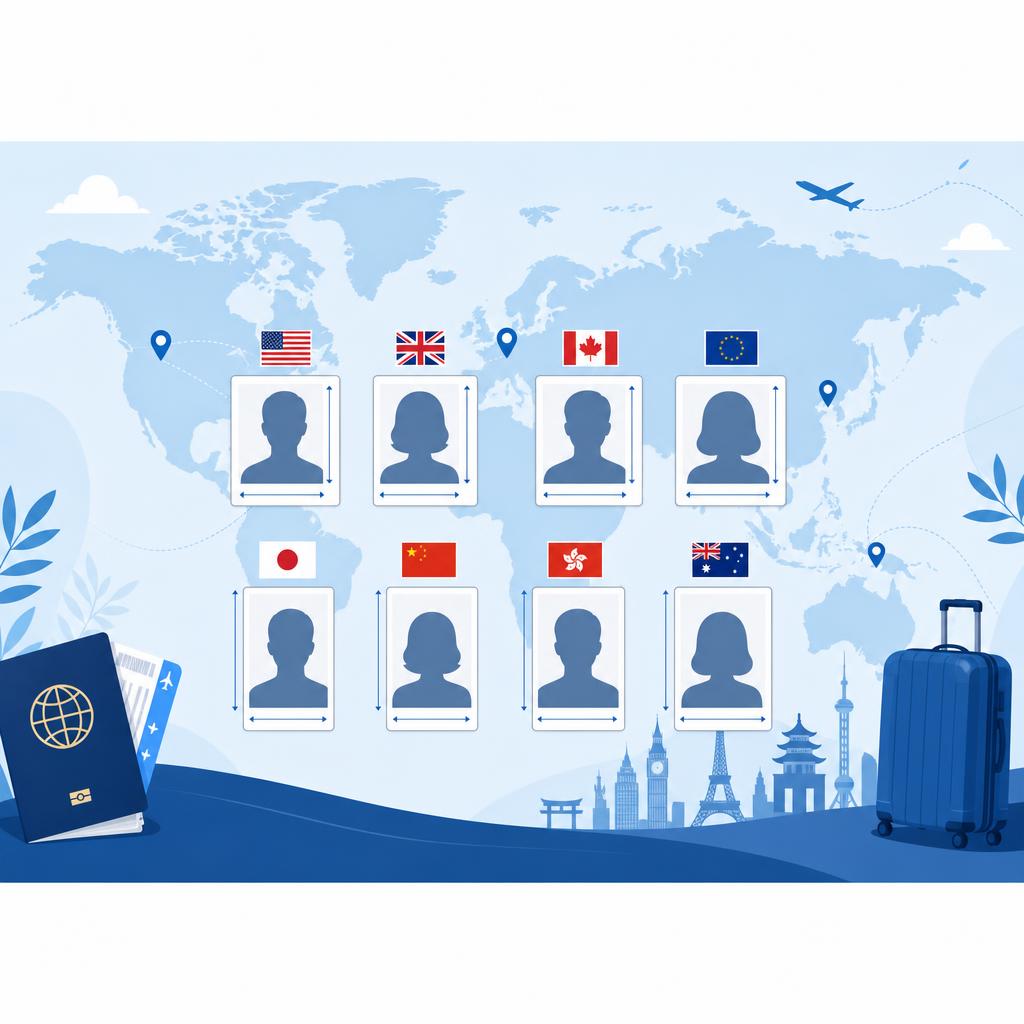
Planning an international trip and need a passport photo? One of the easiest mistakes to make is assuming that every country uses the same passport photo size.
While 35 × 45 mm is the most common passport-photo format worldwide, many countries use different dimensions. The United States uses a square 2 × 2 inch (51 × 51 mm) photo, Canada uses 50 × 70 mm, China uses a different format, and several countries have their own specific requirements.
This guide covers 140 countries, with commonly used passport photo dimensions, so you can quickly find the format you need.
Important: Passport and visa photo requirements can change, and a country's passport photo requirements may be different from its visa requirements. Always confirm the final requirements with the official government or passport authority before submitting your application.
Quick Passport Photo Size Guide
The most common formats you'll encounter are:
- 35 × 45 mm — the most common international passport photo size
- 51 × 51 mm (2 × 2 inches) — used by the United States and some countries for specific applications
- 50 × 70 mm — used by Canada and some other applications
- 40 × 50 mm — used by several countries
- 40 × 60 mm — used by several Asian passport systems
- 45 × 45 mm — square format used by some countries
- 33 × 48 mm — commonly associated with China
- 26 × 32 mm — used by Spain
- Other country-specific sizes also exist
Passport Photo Requirements at a Glance
Regardless of the country, a good passport photo normally needs to meet several basic rules:
- Face the camera directly
- Keep your head straight and centered
- Maintain a neutral facial expression
- Keep both eyes clearly visible
- Use even lighting
- Avoid shadows on the face and background
- Use a plain background
- Do not use filters
- Do not digitally alter your facial features
- Remove sunglasses
- Avoid glare from eyeglasses
- Make sure the photograph is sharp and in focus
- Follow the required photo dimensions exactly
The size of the photograph is only one part of the requirement. Head position, facial size, background color, image quality, file dimensions and how recently the photo was taken can also matter.
140 Countries and Their Passport Photo Sizes
The dimensions below are intended as a convenient starting reference for passport-photo preparation. Some countries have different requirements for passports, visas, residence permits, IDs and online applications.
North America
- United States — 51 × 51 mm (2 × 2 in) — White or off-white; head 25–35 mm
- Canada — 50 × 70 mm — White/light; head 31–36 mm
- Mexico — 35 × 45 mm — Light background; biometric framing
Central America & the Caribbean
- Guatemala — 26 × 32 mm — Light/white; biometric framing
- Belize — 51 × 51 mm (2 × 2 in) — White; biometric framing
- Costa Rica — 51 × 51 mm (2 × 2 in) — White; biometric framing
- Cuba — 45 × 45 mm — White/light; biometric framing
- Dominica — 45 × 38 mm — Light; biometric framing
- Dominican Republic — 51 × 51 mm (2 × 2 in) — White; biometric framing
- Grenada — 38 × 51 mm — White; biometric framing
- Haiti — 35 × 45 mm — White; biometric framing
- Jamaica — 35 × 45 mm — Light/pale blue where specified
- Nicaragua — 40 × 50 mm — White; biometric framing
- Panama — 35 × 45 mm — White; biometric framing
- Saint Kitts and Nevis — 35 × 45 mm — Light; biometric framing
- Saint Lucia — 35 × 45 mm — Light; biometric framing
- Saint Vincent and the Grenadines — 35 × 45 mm — Light; biometric framing
South America
- Argentina — 40 × 40 mm — White/light; biometric framing
- Bolivia — 40 × 50 mm — White/light; biometric framing
- Brazil — 50 × 70 mm — White/light; biometric framing
- Chile — 45 × 45 mm — White/light; biometric framing
- Colombia — 40 × 50 mm — White/light; biometric framing
- Ecuador — 35 × 45 mm — White/light; biometric framing
- Guyana — 35 × 45 mm — White/light; biometric framing
- Paraguay — 35 × 45 mm — White/light; biometric framing
- Peru — 35 × 45 mm — White/light; biometric framing
- Suriname — 35 × 45 mm — White/light; biometric framing
- Uruguay — 35 × 45 mm — White/light; biometric framing
- Venezuela — 35 × 45 mm — White/light; biometric framing
Europe
- Austria — 35 × 45 mm — Light/neutral; biometric framing
- Belgium — 35 × 45 mm — Light/neutral; biometric framing
- Bulgaria — 35 × 45 mm — Light; biometric framing
- Croatia — 35 × 45 mm — Light; biometric framing
- Cyprus — 40 × 50 mm — White/light; biometric framing
- Czechia — 35 × 45 mm — Light; biometric framing
- Denmark — 35 × 45 mm — Light; biometric framing
- Estonia — 40 × 50 mm — Light; biometric framing
- Finland — 36 × 47 mm — Light; biometric framing
- France — 35 × 45 mm — Light background; biometric framing
- Germany — 35 × 45 mm — Light background; biometric framing
- Greece — 40 × 60 mm — Light; biometric framing
- Hungary — 35 × 45 mm — Light; biometric framing
- Iceland — 35 × 45 mm — Light; biometric framing
- Ireland — 35 × 45 mm — White/light; biometric framing
- Italy — 35 × 45 mm — White/light; biometric framing
- Latvia — 35 × 45 mm — White/light; biometric framing
- Liechtenstein — 35 × 45 mm — Light; biometric framing
- Lithuania — 35 × 45 mm — Light; biometric framing
- Luxembourg — 35 × 45 mm — Light; biometric framing
- Malta — 35 × 45 mm — Light; biometric framing
- Moldova — 35 × 45 mm — Light; biometric framing
- Monaco — 35 × 45 mm — Light; biometric framing
- Montenegro — 35 × 45 mm — Light; biometric framing
- Netherlands — 35 × 45 mm — Light; biometric framing
- North Macedonia — 35 × 45 mm — Light; biometric framing
- Norway — 35 × 45 mm — Light; biometric framing
- Poland — 35 × 45 mm — Light; biometric framing
- Portugal — 35 × 45 mm — Light; biometric framing
- Romania — 35 × 45 mm — Light; biometric framing
- San Marino — 35 × 45 mm — Light; biometric framing
- Serbia — 35 × 45 mm — Light; biometric framing
- Slovakia — 35 × 45 mm — Light; biometric framing
- Slovenia — 35 × 45 mm — Light; biometric framing
- Spain — 26 × 32 mm — White/light; biometric framing
- Sweden — 35 × 45 mm — Light; biometric framing
- Switzerland — 35 × 45 mm — Light; biometric framing
- Ukraine — 35 × 45 mm — Light; biometric framing
- United Kingdom — 35 × 45 mm — Light grey/cream; head 29–34 mm
- Vatican City — 35 × 45 mm — Light; biometric framing
Oceania & Pacific Islands
- Australia — 35–40 × 45–50 mm — White/light grey; face 32–36 mm
- New Zealand — 35 × 45 mm — Light; biometric framing
- Fiji — 35 × 45 mm — Light; biometric framing
- Papua New Guinea — 35 × 45 mm — Light; biometric framing
- Solomon Islands — 35 × 45 mm — Light; biometric framing
- Vanuatu — 35 × 45 mm — Light; biometric framing
- Samoa — 35 × 45 mm — Light; biometric framing
- Kiribati — 35 × 45 mm — Light; biometric framing
- Tonga — 35 × 45 mm — Light; biometric framing
- Palau — 35 × 45 mm — Light; biometric framing
- Micronesia — 51 × 51 mm (2 × 2 in) — White/light; biometric framing
- Marshall Islands — 51 × 51 mm (2 × 2 in) — White/light; biometric framing
- Nauru — 35 × 45 mm — White/light; biometric framing
- Tuvalu — 35 × 45 mm — White/light; biometric framing
Asia
- China — 33 × 48 mm — White; biometric framing
- Japan — 35 × 45 mm — White/light; biometric framing
- South Korea — 35 × 45 mm — White/light; biometric framing
- India — 35 × 45 mm — White; biometric framing
- Nepal — 35 × 45 mm — Light; biometric framing
- Bhutan — 35 × 45 mm — White/light; biometric framing
- Mongolia — 35 × 45 mm — White/light; biometric framing
- Philippines — 35 × 45 mm — White/light; biometric framing
- Vietnam — 40 × 60 mm — White/light; biometric framing
- Thailand — 40 × 60 mm — White/light; biometric framing
- Cambodia — 35 × 45 mm — White/light; biometric framing
- Laos — 35 × 45 mm — White/light; biometric framing
- Myanmar — 35 × 45 mm — White/light; biometric framing
- Singapore — 35 × 45 mm — White/light; biometric framing
- Taiwan — 35 × 45 mm — White/light; biometric framing
- Hong Kong — 40 × 50 mm — Light; biometric framing
- Macau — 35 × 45 mm — Light; biometric framing
- Timor-Leste — 35 × 45 mm — White/light; biometric framing
Eurasia & the Caucasus
- Russia — 35 × 45 mm — Light; biometric framing
- Armenia — 35 × 45 mm — Light; biometric framing
- Georgia — 35 × 45 mm — White/light; biometric framing
- Israel — 35 × 45 mm — White/light; biometric framing
Africa
- South Africa — 35 × 45 mm — White/light; biometric framing
- Botswana — 35 × 45 mm — Light; biometric framing
- Namibia — 35 × 45 mm — Light; biometric framing
- Zambia — 35 × 45 mm — Light; biometric framing
- Zimbabwe — 35 × 45 mm — Light; biometric framing
- Malawi — 35 × 45 mm — Light; biometric framing
- Mozambique — 35 × 45 mm — Light; biometric framing
- Angola — 35 × 45 mm — Light; biometric framing
- Madagascar — 35 × 45 mm — Light; biometric framing
- Mauritius — 35 × 45 mm — Light; biometric framing
- Seychelles — 35 × 45 mm — Light; biometric framing
- Ghana — 35 × 45 mm — White/light; biometric framing
- Nigeria — 35 × 45 mm — White/light; biometric framing
- Kenya — 55 × 55 mm — White/light; biometric framing
- Tanzania — 35 × 45 mm — White/light; biometric framing
- Uganda — 35 × 45 mm — White/light; biometric framing
- Rwanda — 35 × 45 mm — White/light; biometric framing
- Burundi — 35 × 45 mm — White/light; biometric framing
- Democratic Republic of the Congo — 35 × 45 mm — White/light; biometric framing
- Republic of the Congo — 35 × 45 mm — White/light; biometric framing
- Gabon — 35 × 45 mm — White/light; biometric framing
- Cameroon — 35 × 45 mm — White/light; biometric framing
- Equatorial Guinea — 35 × 45 mm — White/light; biometric framing
- São Tomé and Príncipe — 35 × 45 mm — White/light; biometric framing
- Liberia — 35 × 45 mm — White/light; biometric framing
- Togo — 35 × 45 mm — White/light; biometric framing
- Benin — 35 × 45 mm — White/light; biometric framing
- Côte d'Ivoire — 35 × 45 mm — White/light; biometric framing
- Eritrea — 35 × 45 mm — White/light; biometric framing
- Ethiopia — 35 × 45 mm — White/light; biometric framing
- South Sudan — 35 × 45 mm — White/light; biometric framing
- Cabo Verde — 35 × 45 mm — White/light; biometric framing
- Lesotho — 35 × 45 mm — White/light; biometric framing
- Eswatini — 35 × 45 mm — White/light; biometric framing
- Central African Republic — 35 × 45 mm — White/light; biometric framing
The Most Important Passport Photo Sizes to Remember
United States — 2 × 2 Inches
The U.S. passport photo is one of the easiest formats to recognize because it is square. The standard printed size is 2 × 2 inches, or 51 × 51 mm. The head should generally measure approximately 1 to 1⅜ inches from the bottom of the chin to the top of the head. The background should be plain white or off-white. For anyone applying for a U.S. passport, do not automatically use the international 35 × 45 mm format.
Canada — 50 × 70 mm
Canada uses a noticeably different passport photo size. Canadian passport photographs are 50 mm wide × 70 mm high, with a chin-to-crown measurement generally between 31–36 mm. Canadian passport photos also have detailed requirements concerning lighting, facial expression, background, image quality and printing. This is one of the biggest reasons you should not assume that a standard 35 × 45 mm passport photograph will work for Canada.
United Kingdom — 35 × 45 mm
The United Kingdom uses the familiar European-style portrait format: 35 mm wide × 45 mm high. The face from chin to crown should generally measure 29–34 mm. The background should be a plain light-colored background such as light grey or cream. UK digital passport applications have additional requirements for pixel dimensions and file size.
Australia — 35–40 × 45–50 mm
Australia is another important exception because its printed passport photo specification allows a range rather than one exact outer dimension: 35–40 mm wide and 45–50 mm high. The face should measure 32–36 mm from chin to crown. The background should be plain white or light grey and provide good contrast with the face.
Japan — 35 × 45 mm
Japan commonly uses 35 × 45 mm for passport photographs. The photograph should show the applicant facing directly toward the camera with a neutral expression and appropriate biometric positioning. Be careful when preparing Japanese visa photographs because some visa applications can have different specifications from the passport.
China — Different From the Standard 35 × 45 mm
China is another country where you should not automatically assume that 35 × 45 mm is correct. Chinese passport and online application systems can use country-specific dimensions and pixel requirements. A commonly referenced format is approximately 33 × 48 mm. Always check the specific Chinese passport or visa application before preparing the final image.
Why Passport Photo Size Matters
A photograph can look perfectly good and still be rejected because it has been prepared at the wrong dimensions. For example, 35 × 45 mm is not the same as 51 × 51 mm. Likewise, 50 × 70 mm is not the same as 35 × 45 mm. Cropping a photograph to the wrong aspect ratio can also change the amount of space around your head and shoulders. That's why it is important to select the correct country before preparing your passport photograph.
Passport Photo Size vs. Visa Photo Size
One of the biggest mistakes travelers make is assuming that a country's passport and visa photos are always identical. They are not. A country may require one size for its passport and another size for a visa issued by an embassy or consulate — for example, 35 × 45 mm for a passport but 50 × 50 mm for a visa, a specific pixel size for an online application, or a different background color for a particular document. Always check the document you are applying for, not just the country you are traveling to.
What Makes a Good Passport Photo?
Regardless of the country, start with a properly taken original photograph.
- Use a plain background — white, off-white, light grey, or another officially permitted background may be required. Avoid patterns, furniture, doors, pictures, curtains, other people, dark backgrounds, and strong shadows.
- Face the camera — your face should be straight toward the camera, centered, level, and clearly visible. Avoid tilting your head up or down.
- Keep a neutral expression — keep your mouth closed, don't smile broadly or frown, and keep your eyes open and visible. Some countries have special rules for young children.
- Avoid sunglasses — regular eyeglasses may be permitted by some countries, but glare, reflections and frames covering the eyes can cause problems.
- Don't use filters — no beauty filters, face-smoothing, AI face changes, skin-changing filters, face reshaping, digital makeup, or artificial backgrounds. A passport photograph needs to represent your actual appearance.
- Use good lighting — lighting should be even across the face. Avoid harsh shadows, flash reflections, dark eye sockets, bright spots, and backlighting.
How to Take a Passport Photo at Home
You don't necessarily need an expensive camera. A modern smartphone can produce a high-quality original photograph when used correctly.
- 1. Find a plain background — stand several feet away from a plain light-colored wall.
- 2. Use good lighting — face a window or use soft, even lighting. Don't stand with a bright window directly behind you.
- 3. Position the camera — have another person take the photograph rather than using a selfie whenever possible. Keep the camera approximately at eye level.
- 4. Look directly at the camera — keep your head straight and your eyes toward the lens.
- 5. Take several photos — so you can select the sharpest one with the best expression and lighting.
- 6. Crop for your country — only after you have a good original image should you crop and resize it for the specific passport application.
Can the Same Photo Be Used for Multiple Countries?
Sometimes, yes. If the original photograph is good enough, the same image may be cropped to meet different size requirements — for example, 51 × 51 mm for the United States, 35 × 45 mm for the United Kingdom or Japan, 50 × 70 mm for Canada, or 33 × 48 mm for China. However, don't simply resize the finished passport photo from one country to another. It is better to return to the original photograph and create a new crop for the new requirement.
What About Digital Passport Photos?
Online passport applications can have completely different requirements from printed passport photos. A digital application may specify minimum and maximum pixel dimensions, file format, maximum file size, aspect ratio, background, facial positioning, and maximum photo age. For example, the UK's digital passport process has specific pixel and file-size requirements in addition to the visual requirements, and Canada's online passport renewal also has separate digital specifications from its printed passport photographs. This means that simply scanning a printed passport photograph isn't always the right solution.
300 DPI Passport Photo Sizes
If you are preparing a photograph for printing, DPI can be useful when converting millimeters or inches into pixels. At approximately 300 DPI, common sizes convert to:
- 2 × 2 inches ≈ 600 × 600 px
- 35 × 45 mm ≈ 413 × 531 px
- 40 × 50 mm ≈ 472 × 591 px
- 45 × 45 mm ≈ 531 × 531 px
- 50 × 70 mm ≈ 591 × 827 px
- 33 × 48 mm ≈ 390 × 567 px
- 40 × 60 mm ≈ 472 × 709 px
These pixel conversions are useful for printing, but a country's official digital application may specify different pixel dimensions.
Don't Confuse Passport Photos With Passport Renewal Requirements
A passport photograph is only one part of a passport application. Depending on the country, you may also need application forms, proof of citizenship, identification, a previous passport, fees, supporting documents, a signature, additional photographs, and digital photo information. Always check the official passport authority for the complete application requirements.
For U.S. passport applicants, confirm the current official photo requirements directly with the State Department:
travel.state.gov — Official U.S. Passport Photo RequirementsFrequently Asked Questions
What is the most common passport photo size? The most common international passport photo format is 35 × 45 mm. However, the United States uses 51 × 51 mm (2 × 2 inches), Canada uses 50 × 70 mm, and numerous countries have their own requirements.
Is 2 × 2 inches the same as 35 × 45 mm? No. A 2 × 2 inch photo is approximately 51 × 51 mm, a square. A standard 35 × 45 mm photograph is a portrait rectangle. They are different shapes and dimensions.
Can I use a U.S. passport photo for a European passport? Not automatically. A U.S. passport photograph is square, while most European passport systems use a 35 × 45 mm portrait format. The original photograph may be usable, but it generally needs to be correctly cropped and formatted for the destination country.
What background should a passport photo have? Many countries require a plain white, off-white or light-colored background. However, the exact background requirement varies by country and document.
Can I smile in a passport photo? Most passport systems require a neutral facial expression with the mouth closed. Children may have different rules.
Can I wear glasses? Rules vary. Some countries allow prescription glasses if the eyes are completely visible and there is no glare or reflection. Other authorities strongly discourage or prohibit glasses. Always check the specific country's requirements.
Can I wear a hat? Generally, ordinary hats and caps should not be worn. Some countries make exceptions for religious or medical reasons, provided the full face remains visible.
How old can my passport photo be? This varies by country. Some authorities require a photograph taken within a specific period, while others have different rules. Don't assume that an old passport photo can be reused simply because you still look the same.
Before You Submit Your Passport Photo
- Correct country selected
- Correct document selected
- Correct photo dimensions
- Correct digital pixel dimensions if required
- Correct background
- Face centered and head straight
- Eyes clearly visible with a neutral expression
- No sunglasses, distracting objects, shadows, filters, or facial alterations
- Image is sharp and in focus
- File format and file size meet the application requirements
- Photo meets the current official requirements
Passport photo requirements are not universal. The biggest mistake is assuming that because a photograph looks like a passport photo, it automatically meets the requirements. Country, document, photo size, facial positioning, background, and digital requirements all matter. Use this 140-country guide as a quick reference, but always verify the final requirements with the official passport, immigration, embassy or consular authority before submitting your application. A few minutes checking the requirements can save you from having your application delayed or your photograph rejected.
If you already have a good photograph, you don't necessarily need to visit a photo studio just to get the correct dimensions. FreePassportSnap.com makes it easy to prepare a passport-style photograph from your existing image — no watermark, no registration. For U.S. passport applicants, you can create the familiar 2 × 2 inch passport photo format directly from your own photograph.
Create Your Free Passport Photo →Previous
Passport Photo for a Bald Head: How Is Head Size Measured?
Next
Passport Says "Mailed" but Never Arrived: What Should You Do?
You Might Also Like

Applying for an Australian Passport? Avoid Third-Party Websites and Use the Official Australian Government Service
Applying for or renewing an Australian passport? Learn where to apply through the official Australian Passport Office, current 2026 fees, passport photo requirements, and how to avoid third-party sites and scams.
Applying for a UK Passport? Avoid Third-Party Websites and Use the Official GOV.UK Service
Applying for or renewing a UK passport? Learn how to use the official GOV.UK passport service, avoid unnecessary third-party fees, prepare your passport photo, and apply safely.

Common Travel Scams to Watch for Before and During Your Trip
From fake booking sites to airport taxi overcharges, here are the travel scams that target trip planning and how to spot each one before it costs you.